
A Conversation with Darius and Levi

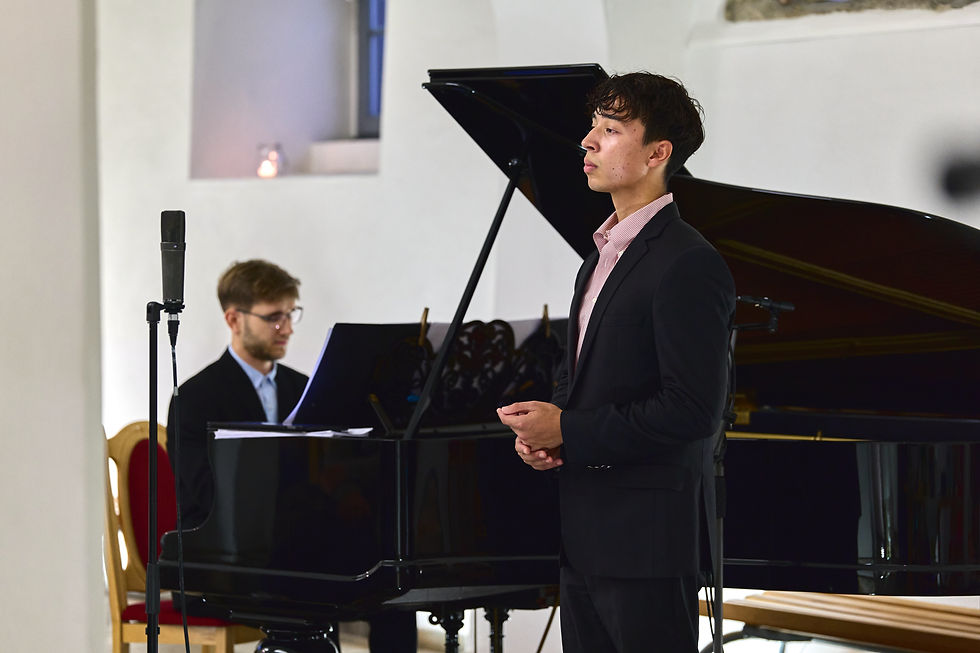
These are a few questions for Levi Fuchs and Darius Herrmann, the young musicians of the opening Lied recital on October 17, 2026, at Krobnitz Castle.

How and when did you meet?
Levi: We first met in the 11th grade at the Sächsisches Landesgymnasium für Musik in Dresden. We were both the only new students in the class. I assume that is something that connected us deeply back then. It gave us a very crucial thing in common right from the start. I already knew his younger brother through my piano teacher at the time, and although I wasn't usually the most talkative person, I approached him right after the first class to mention it. The rest just unfolded over time.
What does working as a duo mean to you? Was it a coincidence, or are there qualities you appreciate in each other that make you want to keep collaborating? Do you have plans for specific music you want to study together? Any plans for future concerts or further competitions?
Darius: Making music at a high level with a close friend is a true privilege for me. Between Levi and me, there was a musical chemistry right from the start that you cannot artificially create: on stage, we react to each other within milliseconds and instinctively feel what phrasing or tonal nuance the other is looking for in the next moment. When you share that level of familiarity, even intense rehearsal work turns into pure joy of experimentation. For the future, we firmly plan to continuously deepen our repertoire as a permanent duo and to enter concerts and competitions together moving forward. Currently, we are working intensively on Schubert's Winterreise—a monumental cycle that challenges us enormously and bonds us together, both musically and personally.
Levi, what do you appreciate most about Darius?
Levi: Wow... tough question. There is so much, but what do I appreciate most? What has influenced me the most and what I incredibly appreciate about him is his courage and openness to tackle challenges without hesitation, to try new things, and—something I usually cannot stand at all—to practically chase after change (metaphorically speaking, it's not actually that extreme with him). Because of him, I have tried and learned many, many new things that have since become passionate hobbies of mine and have completely changed my life for the better.
What I probably appreciate most about him lately is his willingness to be consistently present during genuinely difficult moments for the other person, without letting himself get completely dragged down into that world at the same time. An incredibly valuable quality in a true friend!
On a musical level, you just need to hear his voice to know what there is to appreciate about him. It takes incredibly serious work and patience to develop such a powerful and yet unbelievably flexible voice like his. How he has developed vocally over the last few years is hard to believe—which, of course, motivates me in my own work at the piano as well.
Darius, what do you appreciate most about Levi?
Darius: What impresses me most about Levi is his enormous musicality and a captivating dedication that is instantly infectious. When a piece or an idea grabs him, there is no holding back; he will refine a single phrase with meticulous patience until it exactly matches his tonal ideal. On a personal level, I appreciate his sensitivity and his sense of humor, which ensures that even exhausting rehearsal days always remain cheerful. He also possesses an exceptional talent for organization. He is extremely structured and, during intense working phases, usually knows what’s going to be on the table two meals in advance.
You are both very young but started with music very early. What is the story behind that—how did it all begin? Was it your parents who introduced you to music, or something within yourselves, while the family didn't have much to do with music?
Levi: My family actually doesn't have much to do with music—at least not on a professional level. All of my siblings do something completely different for a living. So, I was the only one heading down the musical path. However, we sang a lot through church, and both of my parents often accompanied congregational singing on the organ as amateurs. My sister took piano lessons for six years. Through the community choir, I started singing early on, at the age of 5, not just by myself but in an ensemble. When I was 9, I had my first piano lessons and was obviously fascinated enough by the instrument.
Darius: For me, the spark was primarily ignited by my father, who is an enthusiastic amateur musician and plays the violin, piano, and organ. Classical music was practically always playing at our house and during car rides, and the Bach cantata on Sunday mornings was a fixed family routine. He also placed a violin in my hands when I was four years old. However, because I spent the whole day constantly trilling children's songs to myself, it quickly became clear to my parents where the journey was truly heading. First, they enrolled me in a church choir, and shortly after, I was allowed to sing in the children's choir at the Staatstheater am Gärtnerplatz, where the magic of the stage finally captured me.
Photo-Gallery mit Levi und Darius
What good things has music brought into your lives? Would you recommend pursuing classical music and singing to other young people, and why?
Darius: Music has enriched my life in every imaginable way, which is why I recommend this world to young people from the bottom of my heart. For me, there is hardly anything more fulfilling than emotionally touching the audience and bringing a smile to people's faces. This motivates me daily to work on myself with discipline. The classical voice has a fascination all its own: the moment when you fill an entire hall right to the very last row without a microphone, solely through body tension and breathing technique, reaching hundreds of listeners—that is pure goosebumps.
Levi: I don't think I am fully aware yet of just HOW MUCH good music has actually brought into my life, is bringing, and will bring in the future. I think it has opened far more doors for me emotionally and intellectually than I realize. And in shattering moments, it has always provided at least some ground to hold onto. The beautiful thing is that music has so many facets—eras, genres, styles. My appeal would simply be: don’t just listen to music, try it out—make it yourself! And the next appeal goes to parents and educators: don't demand a specific kind of music and put them under pressure through expectations, but foster them by listening with interest as often as possible to what they are trying out on their instrument.
How are your studies going in Berlin, Darius? What do you like most, and how do you find the collaboration with your teacher? Are there good mentors, and do you feel well supported?
Darius: Studying in Berlin offers an immensely inspiring environment because the city, with its three opera houses and countless concert venues, provides an incomparable density of artistic impulses. In Roman Trekel, I have found an outstanding teacher with whom I feel completely supported, both vocally and personally. Especially in Lied singing, his experience as an interpreter is of invaluable worth to me. He grants me the necessary artistic freedom and specifically challenges me to develop my own artistic personality and an individual style instead of simply copying a given pattern. A very special sign of trust and an unforgettable experience for me was when I was recently even able to step in for him at short notice.
Is singing Lieder something special to you, or are you planning more of a career in theater? What dreams do you have for your life?
Darius: For me, the stage and the concert hall are by no means mutually exclusive; my passion belongs to opera, concert, and Lied in equal measure, and singing together in an ensemble is also close to my heart. Each of these genres challenges me in its very own way. My biggest dream is simply to do what I love from the bottom of my heart—which doesn't feel like work to me anyway—day in and day out, and to be allowed to make it my profession. That is the real gift for me—no matter how the artistic career path unfolds in detail. To me, it is most important to position myself diversely and to always remain curious as a singer.
Levi, you are planning to go on a mission. Will music play a role there as well (forming choirs, singing songs, teaching piano)?
Levi: Exactly, starting in February 2027, I will be serving a voluntary 2-year mission for The Church of Jesus Christ of Latter-day Saints. I actually really hope that I can be very active musically during this time and perform concerts regularly. To what extent that is actually feasible, however, is always an individual decision that can only be made during the mission. But I am very confident that such opportunities will open up. Music will definitely continue to be a crucial part of my life and my professional future after the mission. From my current perspective, I would very much like to continue studying with a Master's degree in Lied accompaniment, and working as a piano teacher or in music pedagogy in general is also very close to my heart. Parallel to this, however, I will also try to pursue a degree in health sciences or even medicine. My greatest wish for the future is actually to become very active in the field of musicians' health/performing arts medicine.
Aside from music, what other interests do you pursue passionately?
Darius: As a singer, your own body is the instrument, which is why physical fitness is incredibly important to me. I go running regularly and do strength training, which not only gives me the necessary physical stamina for long performances but also clears my head after a long day of rehearsals or concerts. Furthermore, I love learning foreign languages, which fortunately proves to be very useful when studying repertoire. Other than that, I am always up for good food: consciously celebrating a great meal with friends or family is the perfect balance to the everyday life of a musician for me.
Levi: I completely agree with Darius, for me it is also a lot of sports! Running, swimming, as well as strength training. But I also have a great love for any kind of ball sports, especially table tennis. Furthermore, cooking, learning languages, hiking, enjoying nature, spending time with friends and family. Board games/party games!—very important.
What books, films, paintings, or museums have impressed you lately? Can you recommend anything?
Levi: I belong to those very rare personalities who actually don’t like watching movies or series at all. XD I am also not really knowledgeable in the visual arts, even though I have the utmost respect and admiration for them! But one book that I read about six months ago and that has occupied my mind ever since is Atlas of the Heart by Brené Brown—generally a highly recommended author when it comes to dealing with one's own emotions and life experiences, emotional intelligence, and interpersonal connection. Equally recommended by her: The Gifts of Imperfection.
Darius: I was very impressed by the book What I Talk About When I Talk About Running by the Japanese author Haruki Murakami. Although it is superficially about his training for marathons, at its core it is a reflection on discipline, dedication, and the creative process. You don't have to be a runner yourself to relate to his thoughts on perseverance and the joy of one's own development. As a musician, I could immediately find myself in many of his observations about daily routines and mental endurance.
Comments